Visit Kotzebue | Northern Alaska Tours | Inupiat Eskimo Heritage Tours
Alaska above the Arctic Circle: Native Heritage, Arctic Ocean and Wildlife
 |
 |
 |
Day 1: Fairbanks | Anchorage – Kotzebue
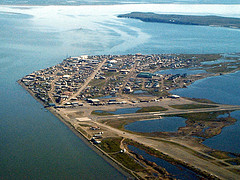
Kotzebue, Alaska, sitting on a 3-mile-long spit at the northwest end of Baldwin Peninsula in Kotzebue Sound, may look isolated. But this town of 3,082, above the Arctic Circle by about 30 miles, is the hub of commerce, culture and outdoor activity for the northwestern Arctic region. It's a popular stop for visitors who want to see a bit of the Arctic landscape and visit the Innaigvik Education and Information Center to learn about the people. The Noatak, Kobuk and Selawik rivers flow into the sound near Kotzebue, allowing boat traffic to carry cargo and residents into the valleys where such villages as Noorvik, Ambler and Noatak lie. Kotzebue is also the center of air traffic in the region. Visitors to northwest Alaska can stop at the Innaigvik Education and Information Center and offices for the National Park Service, Bureau of Land Management and Fish and Wildlife Service to learn more about Kotzebue and nearby wild lands. Somewhat off the beaten path is a tour of a fish camp (optional). You'll get to net, dry and smoke salmon, watch for birds, pick berries and hike in a rustic camp on the Chukchi Sea -- in 24 hours of daylight most of the summer -- five miles down the gravel beach from Kotzebue.
Day 2: Kotzebue - Fairbanks | Anchorage
A casual eye may see a windswept, forsaken district full of mosquito-laden lakes on the flat tundra and long gravel beaches. But what a treasure lies there. The northwest Arctic is a haven for wildlife and a heaven for who subsist on it or merely want to observe it. Birders come with binoculars to see the migratory waterfowl. In this flat area, the Inupiat Eskimos devised their own way of seeing: the blanket toss, in which a group flings an observer high into the air to look for walrus, whales or other game. There isn't much to block the view -- or the wind. Novelist Stan Jones, who lived a number of years in town, writes in his Kotzebue mystery "White Sky, Black Ice" of the "toothachelike persistence" of the west wind. Kotzebue has long winters and cool summers, which means there's ice in the sound from early October until early July. The average low temperature during January is minus 12; the average high during July is 58. The record temperatures are minus 52 and 85. Snowfall averages 40 inches, with total precipitation of 9 inches per year.
The new federal census shows the population of Kotzebue is three-quarters Native, mostly Inupiat Eskimo. The area, occupied for 600 years as a fish camp and trading base, was known long before the German Lt. Otto Von Kotzebue ''discovered'' Kotzebue Sound in 1818 for Russia. According to the Alaska Place Names Dictionary, a reindeer station was established in 1897, and the new permanent community got a post office named after Kotzebue Sound in 1899. With the three big rivers nearby, Kotzebue was a trading hub for groups subsisting on nature's provisions. Chum salmon are important to the subsistence lifestyle, as are the enormous herds of caribou. Musk oxen, bears and smaller mammals also live in the area. In the summer, waterfowl and other migratory birds arrive by the millions to nest in the thousands of lakes and ponds on the tundra and river deltas; some end up on the table.
Kotzebue Sound is surrounded by federal lands, several of which protect both wildlife and archeological sites indicating the arrival of humans over the Bering Land Bridge perhaps 13,000 years ago. Cape Krusenstern National Monument, northwest of Kotzebue on the coast of the Chukchi Sea. Noatak National Preserve, north of Kotzebue. The Noatak River, classified as a national wild river, is protected its entire route. Kobuk Valley National Park, east of Kotzebue. The park is home of a 25-square-mile patch of sand dunes and the Onion Portage archeological dig. Selawik National Wildlife Refuge, east of Kotzebue and south of Kobuk Valley. Bering Land Bridge National Preserve, south of the sound. In addition to its archeological value, the preserve is an important nesting ground.
Tour Including
|
Rates per Person in US $ from Fairbanks or Anchorage
| Tour Number | TA-NAT2 | Daily Departures |
Single | Double | Triple | Quad |
|
May 15 - September 30 | 02-Days Kotzebue Package ex Fairbanks May 15 - September 30 | 02 Days Kotzebue Package ex Anchorage
|
$00.00 $00.00
|
$00.00 $00.00 |
$00.00 $00.00 |
$00.00 $00.00 |
 |